Is Your Phone Reading Your Mind?
The strange feeling that technology knows what we’re thinking and the uncomfortable truth behind it.
There are moments when technology makes me stop and wonder.
Not because of some futuristic robot or a machine doing something extraordinary.
Sometimes it’s something much smaller.
Something almost ordinary.
I think about something.
I didn’t search for it.
I don’t type it.
I don’t tell anyone.
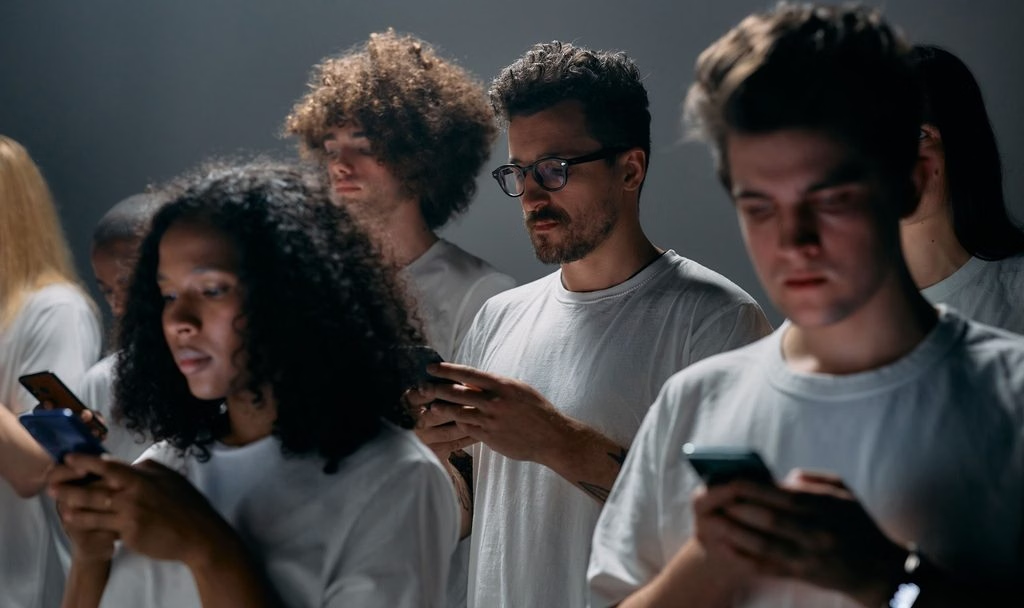
And then, a few hours later, I saw it on my phone.
A video.
An advertisement.
A recommendation.
A post.
Something strangely connected to the thought that was sitting quietly inside my head.
And for a moment, I just stare at the screen.
How did it know?
Have you ever experienced that?
Maybe you thought about buying a particular product and suddenly started seeing advertisements for it.
Maybe you were thinking about travelling somewhere and suddenly your social media feed filled with videos from that place.
Maybe you were talking to someone about something and later your phone seemed to know exactly what you were interested in.
And then comes that uncomfortable thought:
“Is my phone listening to me?”
Or something even more frightening:
“Can technology actually know what I’m thinking?”
I don’t think the answer is as simple as yes or no.
And perhaps the real story is even more fascinating.
Because maybe technology doesn’t need to read our minds.
Maybe it has learned something almost as powerful.
It has learned how to predict us.
Table of Contents
We Like to Think Our Thoughts Belong Only to Us
There is something deeply personal about a thought.
You can hide your words.
You can hide your face.
You can walk away from people.
But your thoughts seem to belong completely to you.
At least, that’s what we have always believed.
I can sit alone in a room and think about a mountain.
Nobody knows.
I can suddenly become interested in learning something.
Nobody knows.
I can think about buying something.
Nobody knows.
Or so I believe.
But modern technology has created something strange.
Our thoughts may remain private, but the behavior surrounding those thoughts often isn’t.
We click.
We pause.
We scroll.
We search.
We watch.
We stop watching.
We return to something.
We follow certain people.
We spend longer on certain videos.
We open an app at a particular time.
We move through the digital world leaving tiny footprints everywhere.
Most of the time, we don’t even notice that we’re leaving them.
But machines notice.
Your Phone Doesn’t Need to Hear Everything
For a long time, whenever someone experienced this strange coincidence, the first explanation was:
“My phone must be listening to me.”
It’s an understandable thought.
We carry microphones in our pockets all day.
Our phones know where we are.
They know which apps we use.
They know what we search for.
They know what websites we visit, depending on the apps and services involved.
They know what we watch.
And many apps ask for permissions that most people accept without thinking very much about them.
So it’s easy to imagine a machine sitting quietly in our pocket, listening to every conversation.
But there is another explanation that is much less dramatic and possibly more disturbing.
The technology already has enough information without listening to everything we say.
Think about how much you reveal through ordinary behavior.
Suppose you suddenly become interested in the mountains.
You don’t search for “mountain trip.”
Instead, you watch a video about Himachal Pradesh.
Then you watch another one.
You stop scrolling for twenty seconds on a video about a small mountain village.
You look at someone’s photograph from the Himalayas.
You follow a travel account.
Maybe you open a map.
None of these actions feels important.
But to a recommendation system, they are signals.
Tiny signals.
And millions of tiny signals can become a remarkably detailed picture.
The Machine Is Watching the Pattern
Imagine I meet you every day.
I notice that you always drink tea around 7 AM.
You usually walk toward the same shop.
Every Sunday, you visit the same park.
One day you mention that you are thinking about buying a bicycle.
Even if you don’t tell me anything else, I can probably make some guesses.
I might guess what kind of bicycle you’d like.
I might guess when you might buy it.
I might guess where you might go riding.
I’m not reading your mind.
I’m observing your behavior.
Technology does something similar—but on a scale that humans cannot really comprehend.
It can compare patterns across enormous numbers of people.
It doesn’t necessarily need to ask:
“What is this person thinking?”
It can ask:
“What do people who behave like this usually do next?”
And suddenly the future becomes a little predictable.
The Scary Part Is How Good Prediction Can Become
Let’s imagine something.
You’ve been feeling tired of your routine.
You haven’t told anyone.
You follow a page about farming.
You read an article about minimalist living.
Eventually your feed begins showing you more of the same.
You might think:
“The algorithm knows that I want to live in the mountains.”
But perhaps something else happened.
You gave the algorithm enough evidence to make that prediction.
And then it started giving you more content related to it.
That content makes the idea stronger in your mind.
You watch another video.
The desire grows.
And now something very interesting has happened.
The machine didn’t simply predict your interest.
It helped strengthen it.
This is where I think we should become much more thoughtful about technology.
Are We Choosing What We See?
We often say:
“I watched this video.”
But that’s not the whole story.
Before you watched it, someone or rather, an algorithm decided that it should appear in front of you.
You didn’t see every video uploaded to the internet.
You saw one particular video.
Then another.
Then another.
And each one influenced what appeared next.
We like to think of our social media feed as a window into the world.
Maybe it’s not a window.
Maybe it’s a filter.
And the filter learns what keeps us looking.
If something makes us angry, we may watch longer.
If something scares us, we may click.
If something confirms what we already believe, we may stay.
If something surprises us, we may share it.
The system learns.
Then it gives us more.
And slowly, our digital world begins to look like the world we are most likely to respond to.
Not necessarily the world as it actually is.
The Algorithm Knows Your Habits Better Than You Think
There is another uncomfortable possibility.
Sometimes technology may understand some of our habits better than we understand ourselves.
Think about your own phone usage.
You might say:
“I only use Instagram for a few minutes.”
But your phone can measure exactly how long you use it.
You might say:
“I don’t really watch that much political content.”
Your viewing history may tell a different story.
You might believe you aren’t interested in something.
Then you notice you’ve watched fifteen videos about it.
We humans have a strange relationship with ourselves.
We don’t always remember what we do.
Machines are very good at remembering patterns.
And Then There Is Coincidence
We should also be careful.
Because sometimes technology doesn’t know anything.
Sometimes we simply notice the coincidence because it feels meaningful.
Imagine you learn a new word.
Suddenly you see that word everywhere.
Did the world suddenly start using it?
No.
You simply became aware of it.
The same thing can happen with advertisements.
Suppose you are thinking about buying a watch.
You have probably seen hundreds of advertisements before.
You ignored them.
But today, because watches are already in your mind, you notice one.
It feels extraordinary.
“I was literally thinking about that!”
And then you forget all the advertisements that had nothing to do with your thoughts.
Our brains are incredibly good at finding connections.
Sometimes the connection is real.
Sometimes it is a prediction.
Sometimes it is a coincidence.
Often it is a mixture.
But Should We Still Be Concerned ?
The bigger issue is something much more ordinary.
We are giving away enormous amounts of behavioral information.
And we often don’t understand how valuable that information can be.
Our attention has become a commodity.
Our behavior has become data.
Our preferences become predictions.
Our predictions become recommendations.
And recommendations can influence behavior.
It’s a cycle.
You click.
The machine learns.
The machine recommends.
You click again.
The machine learns more.
And eventually, it becomes very good at guessing what will keep you there.
Maybe the Machine Doesn’t Know You
This thought changed the way I look at technology.
Perhaps the algorithm doesn’t actually know me.
It knows a digital version of my behavior.
We Are Becoming Predictable
This is the part that makes me uncomfortable.
Not that machines might understand us.
But we might become increasingly predictable.
Wake up.
Check your phone.
Work.
Scroll.
Eat.
Scroll.
Watch.
Sleep.
Repeat.
The algorithm knows what time we’re likely to open the app.
It knows what kind of content we’re likely to engage with.
It knows which subjects hold our attention.
And sometimes it knows what we’re going to click before we consciously decide to click it.
But here’s the question I keep coming back to:
If a machine can predict my next choice, how much of that choice is really mine?
I don’t have a perfect answer.
Maybe nobody does.
The Real Danger Isn’t Mind Reading
Maybe we’ve been asking the wrong question.
Instead of asking:
“Can technology read my mind?”
Perhaps we should ask:
“How much can technology influence my mind?”
That’s a much more important question.
Because reading a thought is one thing.
Influencing the next thought is another.
If I show you ten advertisements for something every day, eventually you may become interested in it.
If I repeatedly show you one kind of lifestyle, you may begin believing that everyone lives that way.
If I constantly show you people who appear successful, beautiful, wealthy and happy, you may start feeling that your own life is inadequate.
The machine doesn’t have to say:
“You should want this.”
It simply keeps putting it in front of you.
Again.
And again.
The Strange Relationship Between Desire and Technology
Sometimes I wonder how many of our desires are actually ours.
Do I want an expensive phone?
Or did I simply see it a thousand times?
Do I want a luxury car?
Or did society teach me that the car represents success?
Do I want more followers?
Or did I learn to measure my worth through numbers?
Do I really need another thing?
Or did an algorithm become very good at finding the moment when I am most likely to want it?
These aren’t easy questions.
For a few minutes, let your mind wander without being directed.
It’s surprisingly difficult.
And perhaps that’s exactly why it’s valuable.
We Don’t Need to Abandon Technology
I’m not anti-technology.
That would be hypocritical.
I’m writing these words using technology.
I use a smartphone.
I use the internet.
I use social media.
Technology has brought enormous good into our lives.
It connects families.
It gives people access to education.
It helps doctors.
It makes communication easier.
It allows a person sitting in a small room somewhere in India to share an idea with someone thousands of kilometers away.
That’s extraordinary.
The problem isn’t technology itself.
The problem begins when we stop using technology consciously.
A hammer is useful.
But you wouldn’t spend your entire day holding one.
A television can entertain you.
But you wouldn’t let it decide what you think about every waking moment.
A phone is useful.
But perhaps it shouldn’t become the first thing we touch in the morning and the last thing we see at night.
We Need to Take Back Some Privacy
There are also practical things we can do.
Check which apps have access to your microphone, camera and location.
Remove permissions that an app doesn’t genuinely need.
Delete apps you never use.
Turn off unnecessary notifications.
Review your privacy settings.
Don’t automatically give every application access to everything.
And occasionally ask yourself:
“Why does this app need this information?”
You don’t have to become paranoid.
Just become aware.
Because privacy isn’t about having something to hide.
Privacy is about having something that still belongs to you.
The Phone in Your Pocket Is Not Your Enemy
I sometimes think we’ve made technology into a villain.
It isn’t.
The phone doesn’t wake up in the morning and decides to destroy our peace.
It’s a tool.
The problem is that the companies building digital platforms have strong incentives to keep our attention.
And we have equally strong human weaknesses:
curiosity,
boredom,
comparison,
fear,
loneliness,
desire,
and the need to belong.
Technology meets all of those weaknesses at once.
That’s why it can become so powerful.
There is something almost rebellious about putting your phone away today.
Not forever.
Just for an hour.
Walk without headphones.
Eat without watching something.
Sit without scrolling.
Let yourself become bored.
Boredom used to be a normal part of human life.
Now we treat it like an emergency.
The moment nothing is happening, we reach for the phone.
Maybe nothing happening is exactly what we need sometimes.
Because when the external world becomes quiet, the internal world finally has room to speak.
We Still Have a Choice
Maybe the future isn’t about choosing between humans and technology.
Maybe it’s about learning how to live with technology without surrendering ourselves to it.
Use the phone.
But sometimes I put it down.
Use social media.
But don’t let it measure your worth.
Use AI.
But keep your own ability to think.
Use algorithms.
But occasionally choose something they didn’t recommend.
Take advantage of convenience.
But don’t become afraid of silence.
And whenever you feel that strange sensation—
“How did my phone know I was thinking about this?”
don’t immediately panic.
Pause.
Ask yourself:
What have I been showing?
And then ask an even more important question:
What have I been showing myself?
Because perhaps the greatest danger isn’t that the machine knows us too well.
Perhaps it’s that we have stopped knowing ourselves.

Final Thoughts
Technology will become more intelligent.
There is no going back.
The algorithms will become better at understanding patterns.
AI will become better at predicting what we want.
Our devices will become more deeply integrated into our lives.
Perhaps one day the line between human intention and machine recommendation will become even harder to see.
That’s exactly why awareness matters.
Not fear.
Not paranoia.
Awareness.
Know what you are giving away.
Know what you are consuming.
Know what is influencing you.
Know yourself.
Because in a world where machines are becoming increasingly capable of predicting human behavior, perhaps one of the most powerful things we can do is remain capable of surprising ourselves.
Put the phone down sometimes.
Walk outside.
Look at the sky.
Talk to someone you love.
Less Noise. More Awareness.
Use technology.
Don’t let technology use you.
Stay curious.
Stay conscious.
Stay human.
